A sparkling note, a low drone, a sudden metallic pluck. These might sound like parts of an experimental soundtrack, but they represent something far beyond a recording studio: stars and clouds of gas observed by space telescopes.
On November 17, 2026, NASA released a new collection of four audio experiences built from observations of regions where stars are forming. The latest NASA star sounds bring together telescope data from the Orion Nebula, the Carina Nebula, Rho Ophiuchi and the galaxy Messier 82.
The new Chandra release offers a different way to explore these places. Instead of relying entirely on colourful images, listeners can follow astronomical features through changes in musical pitch, volume and texture. NASA Science
How NASA Star Sounds Work
The process is called sonification: translating information into sound using a defined set of rules.
Space telescopes send back digital measurements. Scientists can use those measurements to construct images, assigning colours to different kinds of light. Sonification takes another route, representing selected properties through audio.
Imagine reading a map with your ears. A bright feature might produce a louder sound, while separate layers of information might use different instruments. These choices help a listener distinguish features that would otherwise appear as colours or shapes.
As the Chandra sonification project explains, the starting point is astronomical data. The sound is another way to represent it. However, the musical choices matter: changing the mapping would change the listening experience, even if the underlying observations stayed the same. chandra.si.edu
Are These Actual Sounds From Space?
The tracks are not microphone recordings of stars.
Light and sound behave differently. Light can travel through a vacuum; ordinary sound needs matter through which vibrations can move. A telescope detecting X-rays or infrared light is therefore not recording the kind of sound your ears hear.
In these releases, researchers assign audible sounds to measurements after the observations reach Earth. A high note does not mean that a star naturally whistles at that pitch.
NASA’s Webb sonification guide describes the method as a translation that can encode brightness, colour, locations and other information. Understanding that translation makes the experience more useful: the notes become clues to what the telescopes observed, rather than an imagined recording from inside a nebula. NASA Science
Four Places Where Stars Become Music
Each target in the new collection has its own sound treatment.
In Messier 82, a scan moves through observations combining X-ray, visible and infrared light. Brighter sources sound louder, while X-rays occupy the highest audio range.
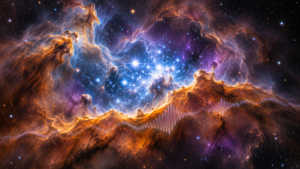
The Orion Nebula turns young stars detected by Chandra into twinkling sounds. Webb’s infrared observations add lower tones and other musical textures.
In the Carina Nebula’s Cosmic Cliffs, individual young stars become short string sounds, while extended X-ray emission receives longer notes.
For Rho Ophiuchi, X-ray sources produce glassy high tones, and stars in the infrared image become metallic plucks. These contrasting treatments help listeners follow different components of each scene in the four new sonifications. NASA Science
Why Combine Different Telescopes?
A stellar nursery contains more than the stars visible in a photograph. Dust, gas and energetic activity contribute different kinds of light.
Our eyes detect only a narrow part of the electromagnetic spectrum. Observatories extend that range, allowing astronomers to compare features that would remain hidden in an ordinary visible-light view.
Chandra detects X-rays. Webb observes infrared light. According to NASA’s explanation of observatory wavelength ranges, different forms of light require different observing capabilities; one telescope cannot cover everything.
Infrared observations are especially valuable in dusty star-forming regions. NASA’s infrared astronomy guide explains how this light helps astronomers study young objects that are difficult to observe otherwise.
Combining these views gives researchers a fuller picture. Sonification then gives listeners a way to separate some of those overlapping layers through sound. NASA Science
What Makes a Star a “Baby”?
Stars begin inside large clouds of gas and dust. Gravity gathers material into increasingly dense regions, some of which collapse.
As a collapsing region heats up, it develops into a protostar. This early object continues changing as material collects and its interior becomes hotter. Eventually, sustained hydrogen fusion establishes the long-lived stage occupied by stars such as our Sun.
NASA’s guide to how stars are born describes stellar nurseries as clouds containing groups of recently formed stars. These are environments where astronomers can examine different stages of stellar development together.
Young stars can also be surprisingly energetic. Chandra’s guide to young stars explains that material falling towards a star can generate X-rays when it strikes gas near the surface. Studying this activity helps researchers investigate what happens during stellar infancy. NASA Science
A Different Way to Explore the Universe
Sonification also makes astronomy available through a sense that scientific images rarely use.
NASA’s data sonification programme allows blind and visually impaired audiences to explore astronomical observations through listening. For sighted audiences, sound adds another way to approach a complicated scene.
When listening, follow the moving scan and read the explanation of its sound mapping. Pay attention to which features produce isolated notes, which create sustained tones, and how the layers overlap.
The latest NASA star sounds offer a reason to revisit familiar space images with fresh attention. A nebula becomes something you can explore over time, following one feature after another as the observations unfold through your speakers.