A black hole containing more than a billion times the Sun’s mass would be remarkable in any galaxy. Finding one alongside another enormous black hole when the Universe was still in its infancy makes the discovery even harder to explain.
Astronomers have reported a compact quasar pair seen as it existed just 900 million years after the Big Bang. Announced on November 10, 2026, the discovery offers a rare opportunity to investigate how supermassive black holes grew alongside the earliest galaxies.
The system, designated J1602+4228AB, has been nicknamed Nāpōwawāʻenakaulua. Researchers identified its unusual nature using the James Webb Space Telescope and Gemini North in Hawaiʻi. Their findings appear in The Astrophysical Journal Letters.
What Makes This Black Hole Pair Unusual?
According to the discovery announcement from Steward Observatory, the two central black holes have estimated masses of approximately 1.5 billion and 400 million Suns.
Their projected separation is about 18,100 light-years. That is enormous by everyday standards, but close on the scale of galaxies.
“Compact” therefore does not mean the black holes are touching or about to collide. It describes their relatively small separation in a galactic setting.
The researchers describe the system as the earliest known compact quasar pair. That distinction matters: it is not a claim to have discovered the first black holes ever formed. We are observing a particularly rare arrangement during an early chapter of cosmic history.
Why Can We See Something That Traps Light?
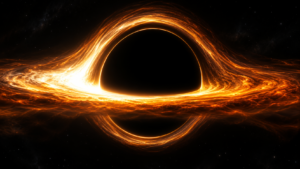
A black hole is a region where gravity is so strong that light cannot escape from within its event horizon. Yet the environment outside that boundary can be extraordinarily bright.
Gas approaching a black hole can form a rotating accretion disk. As the material moves inward, interactions within the disk convert energy into heat and radiation.
A rapidly feeding supermassive black hole can power a brilliant galactic nucleus called a quasar. Its surrounding material may shine more brightly than the stars throughout its host galaxy.
Astronomers are therefore detecting radiation from material around these objects. They are not seeing light emerge from inside the black holes themselves.
The combination makes quasars useful cosmic beacons: their brightness allows researchers to study objects whose light has travelled for billions of years.
The Problem Is Growing So Large, So Quickly
The central puzzle is time.
The Universe is approximately 13.8 billion years old today. These quasars were already active when it was less than a billion years old, leaving a limited window for their black holes to form and accumulate enormous masses.
Black holes can grow by consuming surrounding material and merging with other black holes. However, explaining the largest early examples requires understanding their starting masses, fuel supplies and growth histories.
Feeding is not simply a matter of having gas nearby. Radiation released by hot infalling material can push outward, opposing the inward flow. This competition underlies the Eddington limit, an important reference point in models of black hole growth.
Researchers have investigated whether early black holes experienced unusually intense feeding episodes. NASA’s explanation of rapid early growth describes how intermittent activity could help some black holes gain mass quickly.
The new pair adds another test: a successful explanation must accommodate two massive, active objects in the same early environment.
Did They Start With Bigger Seeds?
Another possibility is that some supermassive black holes began with a substantial head start.
Astronomers use the term black hole seed for an early object from which a larger black hole develops. A seed formed from a collapsed star begins much smaller than a billion-solar-mass giant.
Models involving heavier seeds offer a different route. Under suitable conditions, a large gas cloud could collapse without first fragmenting into an ordinary population of stars.
As NASA explains in its overview of direct-collapse research, beginning with a larger seed can reduce the amount of subsequent growth needed.
These ideas are possible explanations, not conclusions established by this discovery. Observing a massive early black hole does not, by itself, reveal exactly how it formed.
Could One Quasar Be Appearing Twice?
There is an important uncertainty.
A foreground galaxy can bend light from a more distant object through gravitational lensing. In some arrangements, this produces multiple images of a single quasar, creating the appearance of a pair.
The discovery team favours two physically distinct quasars because their spectra differ. Spectra separate light by wavelength, allowing astronomers to compare the properties of apparently neighbouring sources.
However, the announcement’s technical notes on gravitational lensing state that a lens model is needed to rule out that alternative definitively. Steward Observatory
That caveat should remain part of the story. The preferred interpretation is compelling, but further analysis can strengthen or revise it.
What Happens Next?
This system gives astronomers a specific target against which to test competing growth models.
Researchers can investigate whether the surrounding environment supplied enough gas, whether galaxy interactions encouraged feeding, and whether the inferred black hole masses fit different formation scenarios.
It also illustrates why astronomy advances through comparisons. One unusual object raises questions; a growing sample reveals whether it represents an exception or a common stage in galactic evolution.
For now, Nāpōwawāʻenakaulua presents a striking possibility: two enormous black holes were already feeding while the Universe’s first major structures were still assembling. Explaining how they reached that stage could reveal an important part of how galaxies—and their central giants—began.